
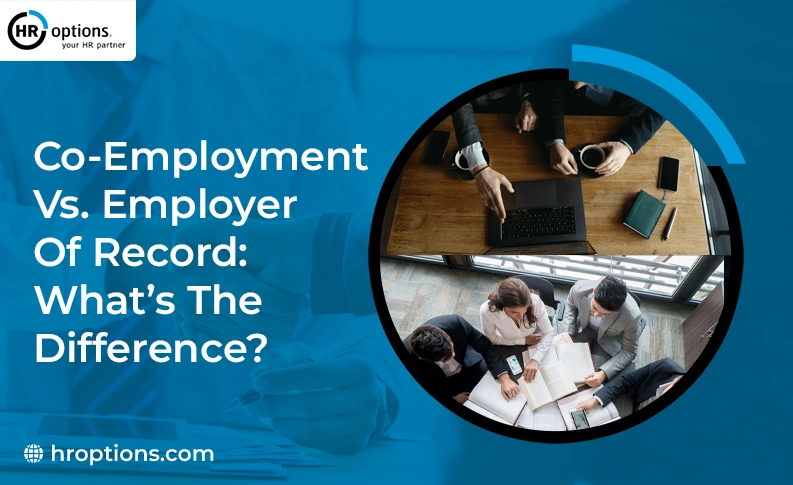
Hiring across states or scaling into new regions sounds simple until you hit payroll rules, tax registrations, state-by-state compliance, and labor laws that seem to change overnight. That’s usually when companies start searching for support and run into two models that look similar at first glance but work in totally different ways: co-employment and an employer of record. Both help you hire faster and stay compliant, but the structure behind each one affects control, liability, HR management, and your long-term growth plans.
A co-employment partner shares responsibilities with you. An employer of record takes on the legal employer role completely. Knowing the difference between co-employment and employer of record helps you choose the model that protects your business, keeps you compliant, and supports your workforce without slowing down expansion.
What Is Co-Employment?
Co-employment is a shared employment model created through a partnership with a PEO (Professional Employer Organization). You still run your business, manage your team, direct the work, and make every operational decision. The PEO becomes your administrative employer to support the HR side.
What a PEO Handles in a Co-Employment Agreement
- Payroll processing and tax administration
- Benefits administration and access to large-group plans
- Workers’ compensation coverage
- Workplace safety and risk mitigation
- Employee handbooks and HR policies
- Compliance monitoring for state and federal laws
- Onboarding documents and employment recordkeeping
You control hiring and firing. The PEO handles the backend infrastructure that keeps everything compliant.
When Co-Employment Works Best
Co-employment is ideal if your company:
- Is growing, but doesn’t want a full in-house HR department
- Wants better employee benefits at better rates
- Needs help with multi-state compliance
- Wants to reduce risk without giving up control
- Prefers to stay the official employer of its workforce
Think of it as your HR engine. You stay in the driver’s seat.
What Is an Employer of Record (EOR)?
An Employer of Record takes the concept one step further. Instead of sharing responsibilities, the EOR becomes the full legal employer on paper. You still manage the employee’s day-to-day work, but the EOR handles every legal, tax, and compliance obligation tied to employment.
What an EOR Does for Your Workforce
- Creates compliant employment contracts
- Onboards employees in any state or country
- Handles payroll, tax filings, and statutory deductions
- Administers legally required benefits
- Manages leave laws and local employment rules
- Ensures terminations follow jurisdiction-specific regulations
- Maintains compliance documentation for every worker
This model is designed for companies that want to hire where they don’t have a business entity. Instead of setting up one, the EOR hires the worker under their entity while you retain full control of the job duties.
When EOR Is the Better Option
An EOR is ideal when you:
- Want to hire in another state without registering an entity
- Need to expand internationally quickly
- Don’t have the bandwidth for local labor law research
- Need to eliminate risk while scaling
- Want compliance handled entirely by an expert team
Put simply: you focus on the team. The EOR handles the legal footprint.
Difference Between Co-Employment and Employer of Record
Let’s look at how these two models diverge once you compare them side by side.
| Feature | Co-Employment (PEO) | Employer of Record (EOR) |
| Legal Employer | Shared between you and the PEO | The EOR is the full legal employer |
| Entity Requirement | You must have your own entity | No entity is required in that location |
| HR Control | You control workforce decisions | You control work but EOR manages all legal employment |
| Scope | Primarily domestic | Domestic and global |
| Compliance Responsibility | Shared between company and PEO | Fully handled by the EOR |
| Payroll & Taxes | Processed under your entity | Processed under EOR’s entity |
| Risk & Liability | Split | Primarily absorbed by the EOR |
| Best Use Case | Companies needing HR support and better benefits | Companies hiring across borders or into new states |
| Speed of Hiring | Moderate | Fast, because no entity setup is needed |
So What’s the Real Difference Between Co-Employment and an Employer of Record?
Co-employment supports your business from inside your existing structure. You stay the primary employer, but you outsource HR administration, compliance support, and benefits management to a PEO. An Employer of Record takes on the legal employer role entirely so you can hire anywhere without opening an entity or learning every state or country’s employment rules.
Both support hiring.
Both reduce risk. But the level of control and legal responsibility shifts dramatically depending on the model you choose.
Conclusion
k. But the level of control and legal responsibility shifts dramatically depending on the model you choose.
When you break it all down, the difference between co-employment and employer of record comes down to how much responsibility you want to share and how fast you want to expand. Co-employment keeps you in full control while a PEO handles payroll, benefits, compliance, and the HR workload behind the scenes. An EOR becomes the legal employer for your hires, making it possible to onboard talent in new states or countries without setting up an entity or navigating complicated labor laws alone.
If you’re trying to decide which model aligns with your growth plans, risk tolerance, and hiring strategy, HR Options can walk you through each approach, explain the legal differences, and help you build the setup that keeps your team supported and your business protected as you scale.